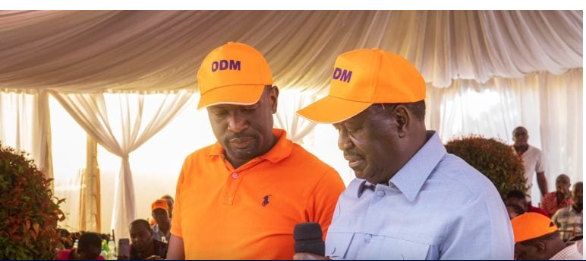
ODM secretary general Edwin Sifuna and party leader Raila Odinga at a past event/FILE
The political landscape in Kenya has recently witnessed a flurry of activity within the Orange Democratic Movement (ODM), particularly concerning the dynamics of party elections in Kakamega County. Central to these discussions is the National Elections Coordinating Committee (NECC), which has found itself in the crosshairs of controversy following rumors of annulled county-level elections.
On a recent Friday, the NECC was compelled to issue a formal statement to debunk claims that it had called for a redo of the Kakamega County Coordinating Committee elections. Their response, characterized by clarity and authority, rejected any assertions that suggested such a directive was given, emphasizing that all information contrary to this should be dismissed as false. The committee urged party members to stay updated through official party communications to avoid misinformation and speculation.
This clarification emerged in the wake of reports alleging that internal conflicts had led ODM to nullify the elections in Kakamega. These elections are crucial not just for establishing leadership within the county but also for the broader aim of strengthening internal democracy across the party’s structures nationwide. ODM has systematically organized grassroots elections, indicating a commitment to promote inclusive decision-making processes.
However, the journey toward reformed structures has not been without its challenges. Kakamega County has seen a particularly heated atmosphere, with various aspirants leveling accusations of favoritism and electoral malpractice boiling into open disputes. The ongoing tensions reflect a deeper struggle for power within the party, underscoring the stakes involved for the candidates.
At the heart of the Kakamega elections was Governor Fernandes Barasa, who successfully retained his position as the county chairman during the party primaries conducted at the Ikolomani KMTC Campus. His victory over Lugari MP Nabii Nabwera was bittersweet, as it was overshadowed by discord over the election process itself. Barasa has been in the chairperson role for two years and campaigned for consensual acclamation, while Nabwera’s faction pushed for a more transparent and democratic secret ballot voting method.
This divergence in voting preferences ultimately led to the postponement of the election, indicating the fraught nature of intra-party politics where both factions could not finalize an agreement on how to conduct the polls. However, the surprise announcement from ODM declaring September 1, 2025, as the date for a repeat election brought the focus back to leadership aspirations, albeit with the backdrop of unresolved tensions.
On the scheduled election day, hopes for a smooth resolution were dashed as the negotiations between the factions faltered despite lengthy discussions that stretched over seven hours. The breakdown in talks culminated in Nabwera’s camp walking out, leaving Barasa’s team alongside election officials led by returning officer Felix Ngara to proceed with the elections. This unilateral approach raised further concerns about the integrity and acceptance of the process among party members.
The entire series of events highlights not only the intricacies of ODM’s internal dynamics but also the fertile ground for political maneuvering in the lead-up to future electoral contests. As ODM navigates these turbulent waters, the outcome of the Kakamega elections could have significant implications for the party’s unity and its strategic positioning moving forward.
As the story unfolds, the importance of clear communication and robust electoral processes becomes evident, serving as a barometer for the health of democracy within political parties. The challenges faced in Kakamega epitomize a broader struggle experienced by many political entities, representing the ongoing quest for legitimacy and representational fairness.