
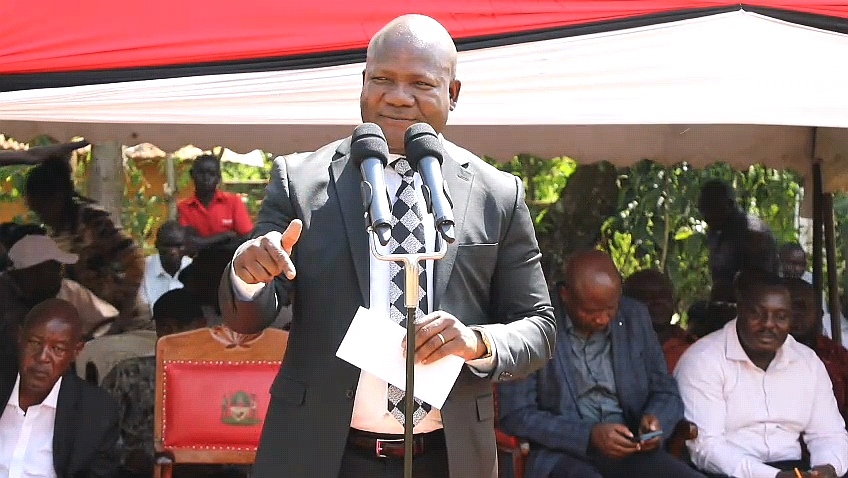
Kakamega Governor Fernandes Barasa addresses mourners at the burial ceremony for Philemon Aoko in Matungu, Kakamega, on Monday /HILTON OTENYO
Kakamega Governor Fernandes Barasa recently emphasized the importance of unity among Luhya leaders as the community prepares for the political landscape ahead of the 2027 general elections. Speaking at the funeral service for Philemon Aoko in Matungu constituency, Barasa articulated a vision that positions the Luhya community as pivotal players in the succession politics following President William Ruto’s tenure in 2032.
Barasa’s call to action resonates deeply with the sentiment shared by many regional leaders who believe that collective strength can significantly enhance their bargaining power on the national stage. He posited that unity is not merely about political alignments but serves as an essential foundation for crafting a viable political and development agenda. “Our brothers from Western, let us have unity of purpose — unity for development and economic empowerment,” he urged, highlighting that such cohesion could potentially facilitate a credible presidential candidate emerging from the region as 2032 approaches.
The governor also underscored the dual necessity of immediate political collaboration and long-term planning. Barasa believes that if leaders maintain a sustained commitment to working together, they can effectively boost development in the region and cultivate a formidable political figure capable of challenging for the presidency. This strategy not only looks towards the future but also aims to address pressing regional needs.
As discussions around the funeral ceremony unfolded, Barasa also made pointed observations regarding the broader national political landscape. He speculated about potential coalitions between the United Democratic Alliance (UDA) and the Orange Democratic Movement (ODM), suggesting that such an alliance could become a robust contender in the forthcoming elections. His comments reflect a growing trend toward broad, inclusive coalitions in Kenyan politics, with an eye toward consolidating power against fragmented opposition forces.
Moreover, Barasa elaborated on Kakamega County’s commitment to supporting Ruto’s re-election bid, emphasizing loyalty as a strategic maneuver for the region. This allegiance, he suggested, could play a significant role in shaping political dynamics in the coming years, ensuring that the Luhya community is not sidelined but rather becomes a key player in the national discourse.
Kakamega Deputy Governor Ayub Savula echoed Barasa’s sentiments, offering sharp critiques of the opposition. He characterized the opposition as disjointed and lacking a coherent vision, suggesting that they had failed to present a viable alternative to the current administration. “The opposition is disjointed and lacks a convincing agenda to rally Kenyans,” Savula stated, pushing back against any claims that could threaten the current ruling coalition.
The dialogue presented at the ceremony illustrated a clear intention among the Luhya leadership to reshape their political narrative, potentially cementing their influence in Kenya’s evolving political theater. Barasa’s remarks indicate a strategic framework built on unity and political alignment that seeks to secure favorable outcomes for the Luhya community over the next decade.
This ambition is not just about reacting to current political climates but also involves proactive measures that prepare the community for significant influence in future elections. As they navigate their way toward 2027 and beyond, the focus remains on fostering connections and aligning interests that will position the Luhya community favorably in national politics.
Simultaneously, the underlying message throughout Barasa’s speech and Savula’s comments stresses a crucial shift in the political powerscape that is important for the Luhya community. By framing their unity as a necessary means to enhance their political leverage, they seek not only short-term gains but also to establish a more prominent and influential presence in future governmental structures.